
Did you know that vigorous exercise keeps you young? You’ve probably noticed that people who put more effort into their workouts look younger. Is it because they have a smaller waistline? A slimmer waist certainly affects how old someone appears, but youthfulness actually begins at the cellular level. By exercising vigorously, you can be up to 10 years younger than your actual age—science tells us so.
A study conducted at Brigham Young University examined 6,000 people between the ages of 20 and 84. It concluded that people who regularly maintain high levels of physical activity have significantly longer telomeres than those who lead a largely sedentary lifestyle or exercise at considerably more moderate intensities.
All this talk of long telomeres may have reminded some readers of the scene in "Love for Three Oranges" in which Pantalone eagerly reads the Pauksons’ astrological guide and tries to work out what exactly this well-developed "foo-oot" might be. "What the hell are telomeres?" even some people who earned top marks in school biology are probably asking now.
In short, telomeres are the nucleotide ends of our chromosomes. They are like our biological clock and are extremely closely linked to age: every time a cell divides, we lose a tiny part of these ends. Therefore, the older we get, the shorter our telomeres become.
However, this study found that the shortening occurs more slowly in people who exercise vigorously. It is therefore fair to say that vigorous exercise keeps us younger, and the cells of vigorous exercisers appear nearly 10 years younger than their actual age.
What counts as vigorous exercise?
Just how relative the concept of intensity can be becomes particularly clear when you read Riigikogu members’ social media posts about how difficult and intense their work is, then compare them with photos of rows of empty seats in the chamber.
The researchers behind this study defined vigorous exercise as at least 30-40 minutes of effort at least 5 times a week, at an intensity equivalent to running or higher. This is even slightly more than the upper end of the WHO physical activity recommendation. The WHO recommends 75-150 minutes of vigorous-intensity physical activity per week for adults.
A 30-minute walk after breakfast is therefore not intense enough to produce this positive effect. Of course, morning walks have all sorts of other pleasant benefits: they burn calories, induce an enjoyable, meditative, flow-like state and help your dog feel lighter. So there’s no need to skip your morning walk, but unfortunately, it does not count as a substitute for a workout.
For a moment, let’s take a slightly less scientific approach and ask some excellent trainers—who generally do not examine people at the cellular level or under a microscope—why we should add vigorous exercise sessions to our daily schedules.
Nike’s head trainer in the Baltics, Britta Alep, recommends adding vigorous workouts to your training plan to support well-rounded development. This applies, for example, when someone is accustomed to exercising at a lower intensity and their body has already adapted to the training load. In that case, more vigorous workouts should gradually be added to the training plan.
"There is also an important emotional reason to challenge yourself from time to time, for example with a HIIT workout. The feeling that comes from exertion and the release of so-called feel-good hormones are sure to create a sense of well-being that puts a sparkle in the eye of any committed fitness enthusiast," Alep says, summarizing her reasons why vigorous exercise is beneficial.
Recommendations and summary
Exercise actively for at least 30 minutes every day—at an intensity that has you sweating by the end.
If you want to be younger than your actual age, find the cardio or HIIT categories in the FitQ video catalog and press the "play" button.
Further reading
Full study in the journal Preventive Medicine: https://www.sciencedirect.com/science/article/abs/pii/S0091743517301470
Brief news summary on the BYU website: https://news.byu.edu/news/high-levels-exercise-linked-nine-years-less-aging-cellular-level
WHO physical activity recommendations: https://www.who.int/news-room/fact-sheets/detail/physical-activity
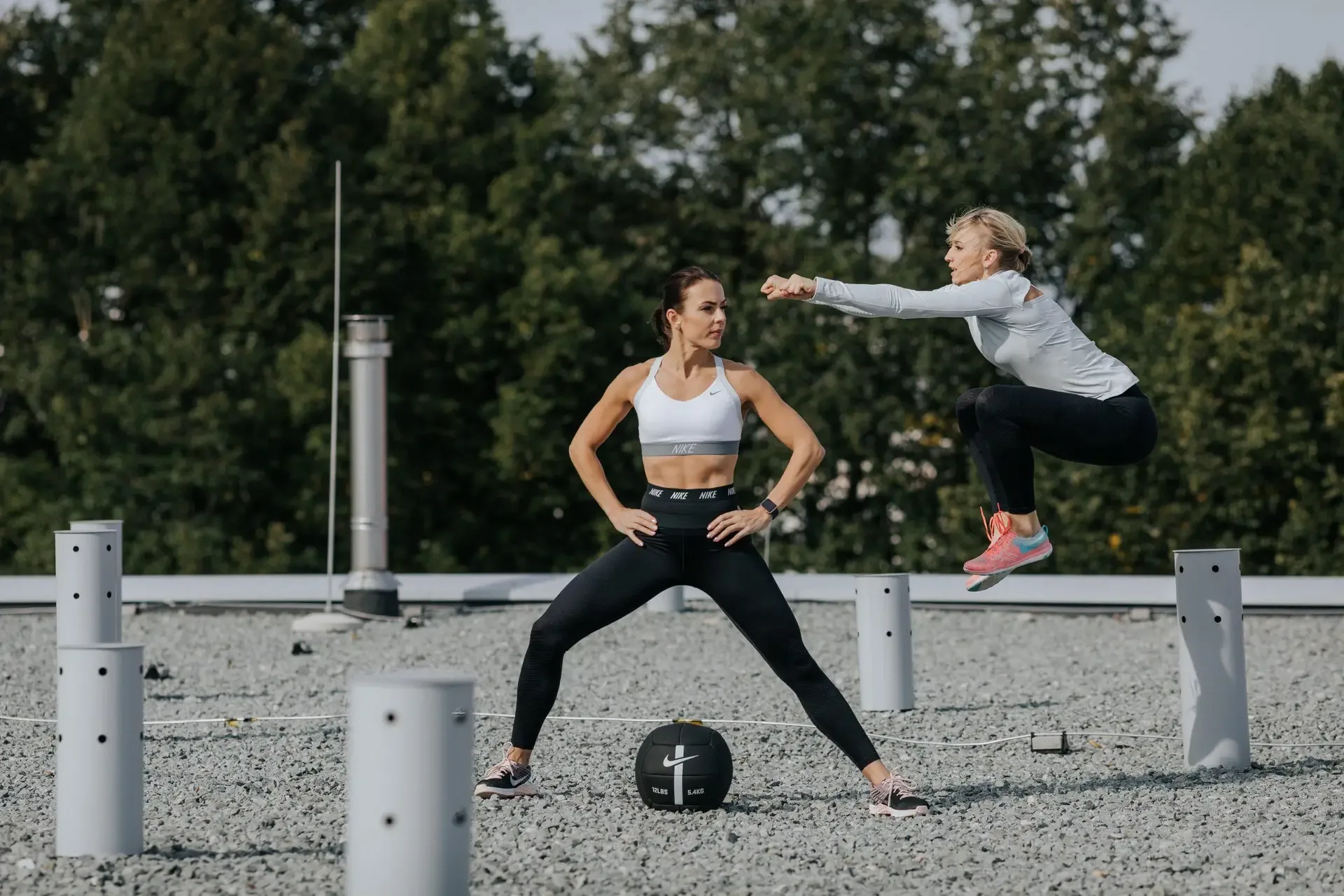
Cover photo: Gerry Sulp. Pictured are trainers Britta Alep and Sandra Raju.
