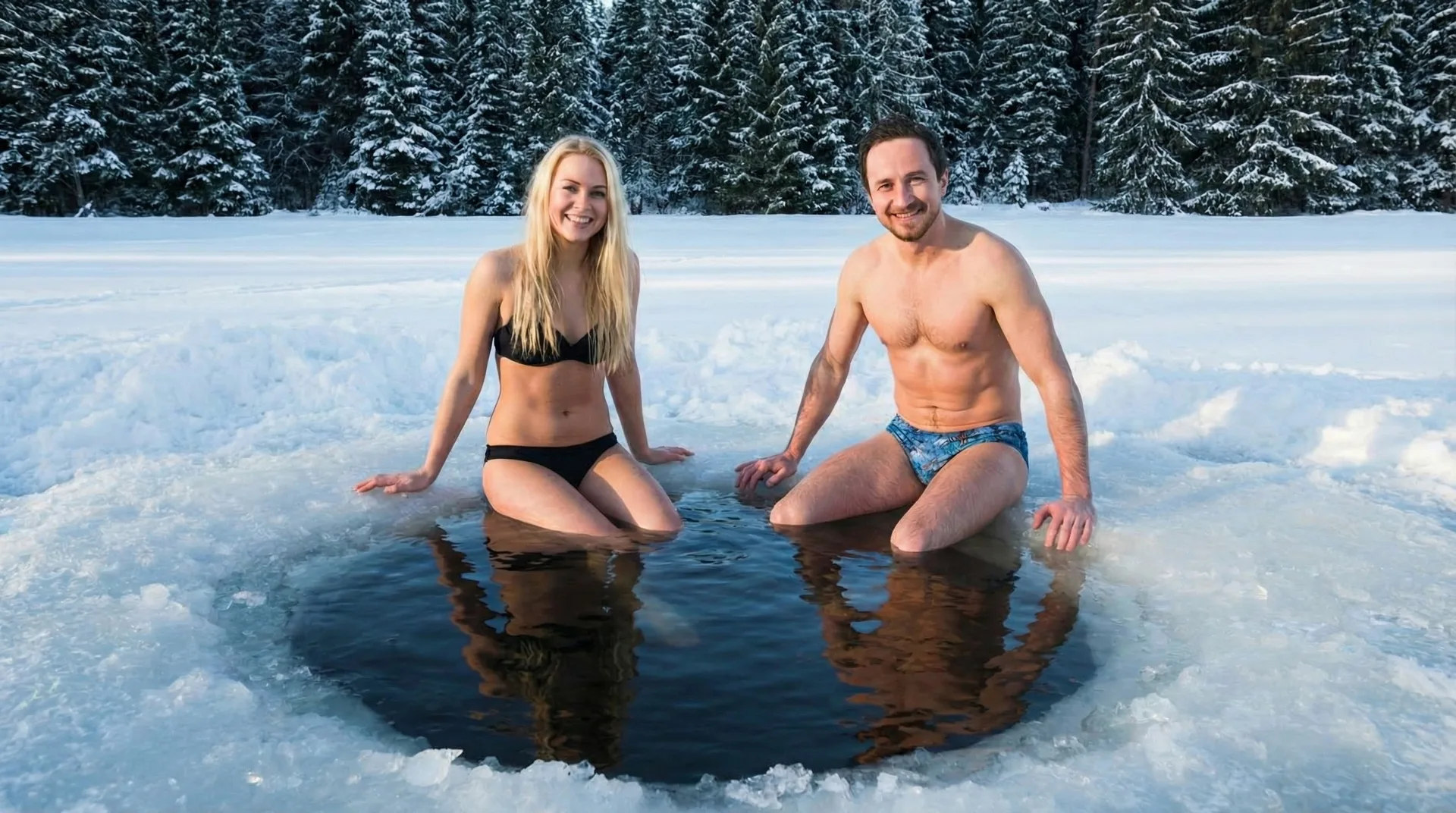

Ice baths and winter swimming have acquired an almost mythical status in recent years. People talk about fat burning, “boosting metabolism” and even miraculous effects on body weight. The reality is far more nuanced.
So, how does cold actually burn calories, and what can you do if jumping into an ice hole feels more like self-torture than a sensible way to improve your health?
How do ice baths and winter swimming burn calories?
Let’s start with the most important point: cold exposure uses energy, but not in the way most people imagine.
Immediate energy expenditure
When you are in cold water (0–4 °C), your body does everything it can to maintain its core temperature.
5 minutes in an ice bath burns approximately 40–60 kcal
After you get out of the water, your body uses another 20–60 kcal or so to warm itself back up
Altogether, that amounts to around ~70–110 kcal per session. That is not an insignificant number, but it is hardly revolutionary either. The actual figure also depends on many different factors.
The brown fat effect
Humans have brown adipose tissue, whose purpose is not to store energy but to burn it to produce heat. Regular exposure to cold:
activates existing brown fat
improves cold tolerance
increases energy expenditure only while you are exposed to the cold
The role of the nervous system
Cold activates the sympathetic nervous system:
noradrenaline levels rise
you feel more “alert”
you often move more throughout the day, even without noticing it
This is another reason cold-water exposure may lead to faster weight loss—not because of the calories it burns, but because of changes in behavior.
Why does weight drop quickly at first?
Many people experience noticeable weight loss during the first 1–2 weeks after starting winter swimming or taking ice baths. This is mainly due to:
a reduction in fluid retention and inflammatory swelling
the release of glycogen and the water associated with it
reduced appetite
This is real weight loss, reflected by real numbers on a real scale, but it is not all fat. Even so, you may begin to feel lighter and better quite quickly. Unfortunately, weight loss does not continue at the same rate in the following weeks.
What do ice baths and winter swimming unfortunately not do? This is where the myths collide with reality.
They are not a miracle fat-loss solution
Burning 100 kcal a day will not produce significant fat loss on its own.
Fat loss still requires:
a calorie deficit
physical activity
consistency
They do not replace exercise
An ice bath:
does not build muscle
does not improve endurance
does not increase maximal oxygen uptake
It may support your training, but it will not do the work for you.
The effects do not continue indefinitely
The body adapts very well to cold.
The more accustomed you become, the:
less you shiver
more efficiently you retain heat
smaller the additional energy expenditure becomes
This is an evolutionary survival mechanism: your body adapts to the stress caused by cold exposure.
They are not suitable for everyone
Heart problems, blood pressure disorders or excessive stress can make cold exposure harmful rather than beneficial.
If an ice bath feels too extreme: sensible alternatives
The good news is that many of the benefits can also be achieved through much gentler methods.
Cold showers
30–90 seconds
simple and accessible
a stimulating effect on the nervous system without the shock
Contrast showers or a sauna followed by cool water
supports circulation and recovery
less stress and more enjoyment
more sustainable than ice baths for many people
Exercising in cool conditions
walking in cool weather
wearing lighter clothing
allowing your muscles to produce heat naturally
From the perspective of calorie expenditure, this is often more effective than sitting passively in the cold.
Managing stress and improving sleep
Many of the “miraculous” effects attributed to cold exposure actually result from a better-balanced nervous system, lower cortisol levels and a steadier appetite. You can often achieve similar results by reducing your stress levels and getting enough sleep on a regular basis.
The boring but effective classics work too: strength training and daily physical activity boost long-term metabolism, produce lasting fat loss and do not require an ice hole.
Summary
Ice baths and winter swimming:
burn calories, but only moderately
affect body weight indirectly, primarily through behavior and the nervous system
are not a shortcut to fat loss
If you enjoy them, great—use them as a tool. If not, do not worry. The same benefits for health and body weight can be achieved through far less extreme methods. Ultimately, your body does not care how cold or uncomfortable you felt; what matters is what you actually did to improve your health.
