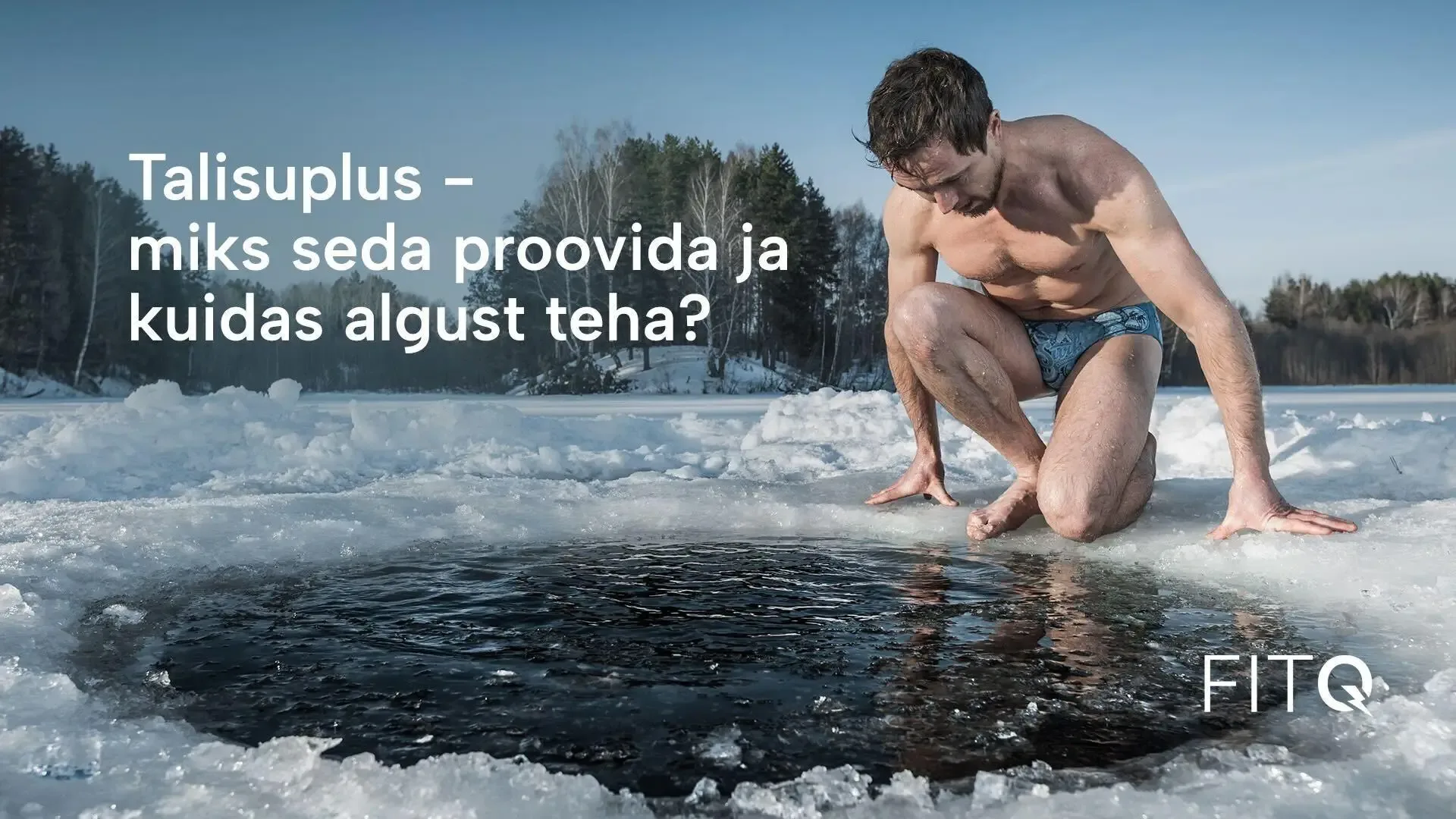

Winter dipping has received more and more attention in recent years. It seems that when colder weather arrives, almost everyone has a friend who posts a photo from a chilly beach or a hole cut into the ice. On the one hand, the idea of winter dipping may sound absolutely terrifying; on the other, it is also exciting—but what exactly makes it so appealing?
In this article, we explore the world of winter dipping—why and how to get started, what equipment you may need and which risks to keep in mind. Two FitQ trainers, Melissa and Laura, also share their experiences of winter dipping, while multiple ice swimming world champion Henri Kaarma contributes his expertise. In addition to winter dipping, which is more familiar to recreational enthusiasts, ice swimming also exists as a sport in its own right. We discuss ice swimming in this article as well, and Erkki Kasenurm, one of the organisers of the annual Ice Swim Festival, tells us more about the event.
Winter dipping as an immune system booster and source of energy
When discussing the benefits of winter dipping, strengthening the immune system and “toughening up” are often mentioned first. Winter dipping has also been found to improve circulation and reduce inflammation. It also offers a mental challenge, as overcoming the sudden discomfort caused by the cold is a genuine personal achievement.
Melissa says that she feels more energetic after winter dipping—an effect that could even be described as euphoric. After her swim, she feels more alert, refreshed and energised for the rest of the day. Henri agrees, saying that winter dipping produces a powerful rush of endorphins.
Laura likewise feels that winter dipping acts as a reset for both body and mind and helps relieve stress. It can be considered a physically and mentally refreshing experience.
Everyone who can should give winter dipping a try
Winter dipping is suitable for curious and courageous people for whom it is not directly contraindicated. Melissa believes it is suitable for anyone who wants to try it and challenge themselves in a slightly different way. She has seen both children and elderly people winter dipping. Henri recommends that all healthy people try it—they may find that they enjoy it. However, he says that anyone with heart problems should consult a doctor first. All the interviewees agree that every healthy person should try winter dipping at least once in their life.
Getting started with winter dipping—at home, in open water or with a winter swimming club
There are several ways to start winter dipping, and depending on your circumstances and the options available, you can get your first taste of it at home, at a spa or in a cold body of water. Laura suggests taking it one step at a time. You can begin by experimenting with cold water in the shower, and it is very important to adapt to the cold gradually. Start with brief exposures, then slowly increase the amount of time you spend in the water if you wish.
Laura believes that if you decide to try winter dipping outdoors, you should also ease into it gradually—wet your feet first, then your hands, and splash some water onto your arms and shoulders. Once your body has adapted, it will be easier to get all the way in. Breathing plays a major role in winter dipping and cold-water exposure—you need to establish a steady rhythm and keep it under control. Slow breaths help the body relax, although your initial reaction to the cold may be to hold your breath automatically or find it difficult to breathe. You can experiment with the Wim Hof methods to practise your breathing. Laura says that she initially likes to warm herself up with the so-called “fire breath” technique, which involves particularly active breathing. When entering the water, however, you need to slow and calm your breathing and quiet your mind. Melissa recommends starting to acclimatise to cold water in late summer or early autumn. Even then, it is important to begin with shorter periods in the water and gradually extend them.
Although you can gradually try winter dipping alone in the shower or in open water—provided you do so safely and in a familiar place—Henri recommends contacting others who have already discovered it. You can find various winter swimming clubs on social media, with clubs now operating in every city as well as in smaller communities. Some clubs have a sauna and changing room, while others simply meet beside an open body of water and enter from the shore together. Trying it with others allows you to follow their example and learn from their experience.
Winter dipping requires no special equipment, but it does require preparation
All the interviewees agree that winter dipping is not a hobby that requires a lot of specialised equipment. What matters more is planning in advance how you will warm up afterwards. It is best to choose a location you know, as jumping into the water in an unfamiliar place can be dangerous, particularly in cold weather. Winter dippers usually wear swimwear and bring a towel. In colder weather, a hat is also important and should ideally stay on when you enter the water. Laura and Melissa emphasise the importance of warming your body after getting out. You can use a towel or bathrobe, put something warm on your feet and wear gloves.
Laura notes that special gloves and booties are available for winter dipping, but she believes they are intended more for serious swimmers and are unnecessary for recreational participants. Henri similarly mentions neoprene gloves and booties and says that although you can use them, dipping without them provides a more authentic experience. If a warm sauna is available, Henri recommends going into the water first and then warming up in the sauna. If there is no sauna, you need to dress warmly. When planning your swim, avoid bringing tight-fitting clothes to put on afterwards, as pulling them over damp, chilly skin is difficult and unpleasant.
It is important to be aware of the risks
All the interviewees confirm that you need to dress appropriately after your dip and pay particular attention to protecting your head and fingers from the cold. Laura points out that lingering by the water to chat afterwards can leave you at risk of becoming chilled. The water itself may be above freezing, but the outdoor temperature can be below zero and the weather windy, so you should remove your wet clothes as soon as possible after leaving the water.
Melissa stresses the need to warm yourself up, while Henri adds that although warming up is important, you should not go into a hot sauna or hot water immediately after winter dipping. You should warm up gradually. Laura also reiterates that dipping alone can be dangerous, so it is better to build the habit and enjoy the hobby safely with a friend or family member.
One try may be enough to get you hooked—the appeal is immediate
Melissa’s experience with winter dipping began gradually in 2020–2021. She started in late September by running around 5–6 km and then dipping herself in a river. During the winter, she would also go for a dip in a river or the sea after activities such as strength training. On a few occasions, Melissa tried going straight from home into the water “cold,” without warming up first, but found this more difficult mentally. Warming up her body through movement or exercise made the winter dipping experience more enjoyable. Starting winter dipping was a major personal challenge. Melissa says it was something she had thought she would never do in her life. And yet that was precisely why she decided to try it: it represented such a significant challenge. She proved to herself that she could overcome her fear, and ultimately she grew to enjoy winter dipping and found that it gave her a wonderful boost of energy and a sense of well-being.
Laura has been going into ice holes after the sauna since childhood and has entered the water “cold,” without warming up first, since 2019. Winter dipping became a habit when Laura’s family decided together that they would start swimming in cold water. Laura has set herself a rule that if something does not directly harm her, she will try it at least once. If she does not like it, she has at least given it a try and does not have to do it again. Laura was surprised, however, when she found that she actually enjoyed winter dipping and that it gave her positive energy. It has now become such a pleasant lunchtime break that Laura goes straight from her laptop and work to take a quick dip.
From winter dipping to ice swimming
Henri describes his experience through swimming. By 2007, he had completed his first marathon swims and realised that it was also possible to swim in winter. Cold water was initially a personal challenge for him, but he reminded himself that Finland reportedly had 100,000 winter swimmers. If so many people there went into the water in winter, it could not be completely impossible. One November evening, Henri dashed into the water at Kakumäe Beach, immersed himself up to his neck and sprinted back to shore. The entire adventure lasted only a minute or two, but he was extremely pleased with himself. Like everyone who starts winter dipping, he experienced a powerful dose of endorphins, and winter dipping and ice swimming became a habit for him from then on. Henri has since made a name for himself in the world of ice swimming—competitive swimming, that is—and is a multiple ice swimming world champion. In addition to overcoming his own limits, he has therefore found another way to challenge himself in this world.
Ice swimming competitions in Estonia—the Ice Swim Festival
When we talk about winter dipping, we mean immersing ourselves in cold water and perhaps spending a few minutes there. Ice swimming, however, means something different. It refers to conventional swimming in an outdoor body of water during winter when the water temperature is below 10°C. Ice swimming is competitive: the main goal is not so much to toughen yourself up as to get from point A to point B as quickly as possible. At the same time, the cold-water conditions make it very different from other swimming competitions.
Estonia also hosts ice swimming competitions and has held an ice swimming festival for several years. This year’s festival took place during the week of 28 November–4 December, so it was held only recently. Erkki Kasenurm, one of the festival organisers, says that this was the third year the festival had been organised in its current form, while the organising team has been active for four years in total, with no festival held in 2019. Competitions had also been held previously, but the way they were organised changed. The Ice Swim Festival organisers have seen how competitions are run abroad—in Latvia, Russia, Belarus and Slovenia—and have taken note of the best ideas. They use their own event to offer people an opportunity to experience something new and bring plenty of enthusiasm to the task. Erkki says that one of the wonderful things about ice swimming is seeing people enter the water smiling and come out smiling too.
Erkki describes the Ice Swim Festival as follows: “The festival is divided into two parts:
1. Athletes who come to compete for honour and glory. This time, Tallinn hosted the opening round of the World Cup, with 13 countries represented in total.
2. Recreational swimmers whose primary aim is not to be the fastest—after all, there can only be one winner—but to enjoy doing something together. As festival organisers, our goal is specifically to bring these ‘backyard pond splashers’ together for a shared event and celebration. In previous years, we have organised a so-called record swim. The record relay swim set in 2020 should still stand: 505 swimmers took part, with every participant swimming 25 metres in a style and costume of their choice.”
If you feel inspired, go and give it a try!
If you have never tried winter dipping before and have been wondering whether and how to get started, we hope this article has given you some ideas and inspiration.
Remember to start gradually. When trying winter dipping in open water, choose a familiar place and preferably do not go alone. Before your dip, think through how you will warm up afterwards and make sure you have everything you need. Prepare warm clothes, a hat, gloves and perhaps access to a warm room so that your experience is both memorable and safe. If you would like to try ice swimming with others, look for a winter swimming club where you can gain experience. We wish you a refreshed mind and many enjoyable dips!
