
This article comes from our archives, from a time when FunTastyQ Fit was still called Geneto Elustiil. We keep our older articles available—our product has a long history.
Many of us are unhappy with our body weight, and the news constantly reminds us of the growing obesity epidemic. How overweight is the average Estonian, and how much weight do we want to lose on average?
The FunTastyQ Fit team has a fairly good picture of the current situation. We have analyzed anonymous data from more than 57,000 users of the FunTastyQ Fit app (then called Geneto Elustiil), giving us an impressive amount of information from which to draw conclusions. However, one thing needs to be made clear first: our sample does not represent the average Estonian, but rather the average Estonian who considers a healthy lifestyle important. People who do not prioritize it are unlikely to download health apps, so we do not have their data for comparison. Now that we have got that disclaimer out of the way, we can dive into the data.
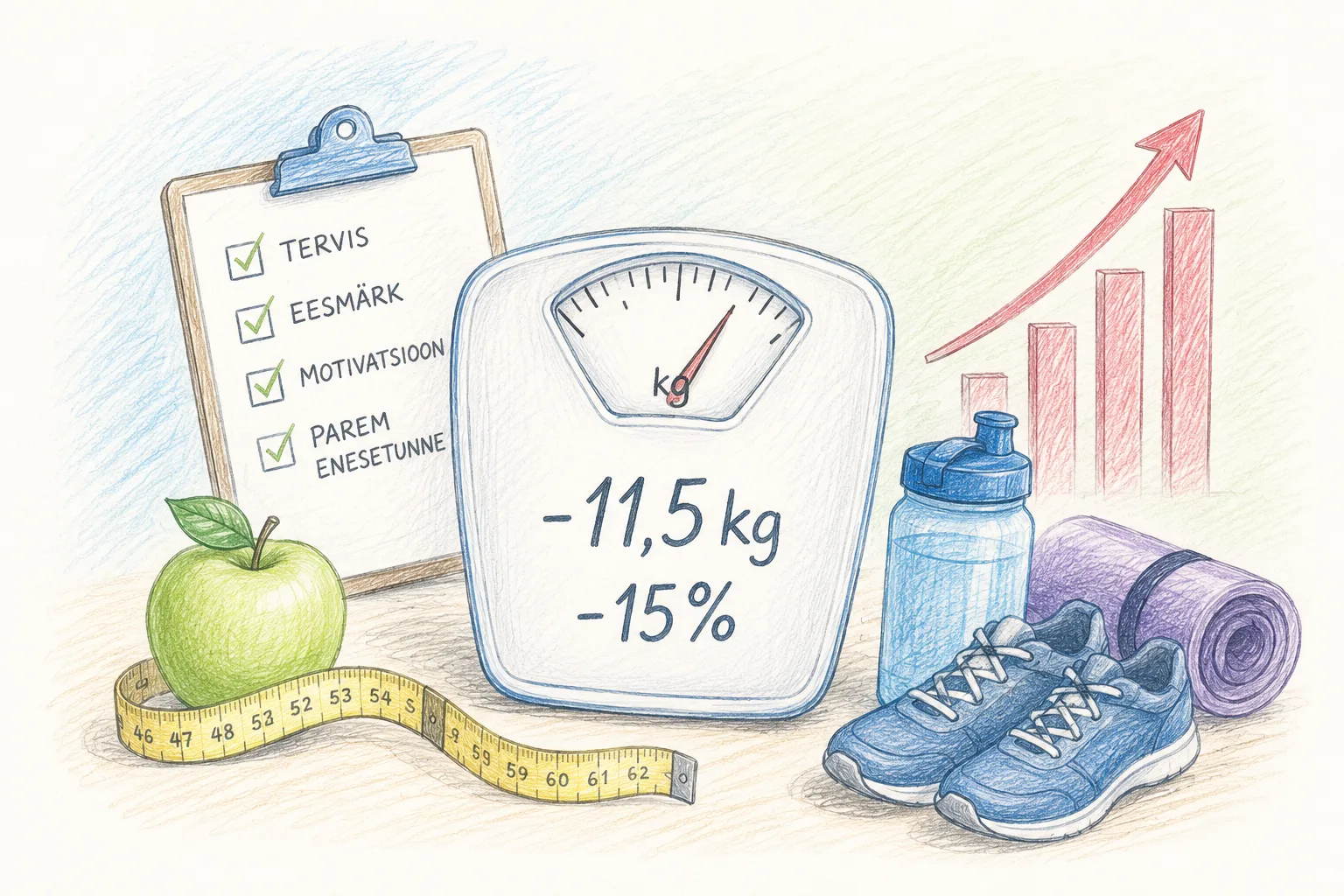
The average user weighs 11.5 kilograms more than they would like
Crunching the numbers and calculating an average is not particularly difficult. An analysis of anonymous data from 57,537 FunTastyQ Fit users—including their current weight, target weight, height and desired change—shows that the average app user begins their journey hoping to lose 11.5 kilograms. Our users’ average starting weight is 77.4 kg, while the median is 74.6 kg. The median is the midpoint: 50% of users weigh more and the other half weigh less. The nearly 3 kg difference between the mean and the median indicates that a small number of significantly heavier people pull the mean well above the median.
The average user’s idea of their ideal weight is 65.8 kg, with a median of 64.0 kg. More important than the number of kilograms is the percentage of body weight it represents. Before we get to those percentages, however, it is worth noting that analyzing the average across all users is not necessarily the most informative approach.
Who wants to lose weight—and who wants to gain it?
Although a large proportion of users aim to lose weight, some want to maintain their weight, while others want to gain it. Since 89.3% of app users have embarked on a healthy eating journey with the goal of losing weight, the overall averages are heavily skewed toward weight loss. Even so, 5.7% of users have set a goal of gaining weight. It therefore makes sense to divide users into groups based on their goals. Let us look at those groups separately.
Women are more ambitious than men
Among users who want to lose weight, 79.9% are women and 20.1% are men. Women’s targets are also considerably more ambitious. Women want to lose as much as 15.7% of their body weight (12.9 kg), compared with 14.3% (14.6 kg) among men.
There were no significant variations between age groups. The desired percentage was almost identical across every age group, at 15.4–15.5%. In the youngest age group (18–24), this amounted to 11.6 kg, while in the oldest group (55+) it was 14.3 kg. The figure increased steadily in the age groups in between, which is probably logical—younger people weigh less than older people. Regardless of age, however, users dream of shedding roughly one in every seven kilograms to reach what they consider their ideal weight.
It is also interesting to analyze how many users set themselves a relatively easy target—losing 1–10% of their weight—how many choose a moderately challenging goal of 11–20%, and how many really plan to “go all out.” Broadly speaking, these groups are divided fairly evenly into thirds. Some 33.9% are satisfied with a smaller change, 39.4% are slightly more ambitious, and 26.7% are the radicals.

A slightly different breakdown among users looking to gain weight
People who aim to gain weight are primarily men (58.7%). Men want to add 6.5 kg (9.9%) to their weight, while women want to gain 4.9 kg (10.2%). In percentage terms, women are once again slightly more ambitious and set themselves bigger goals, even though the increase in kilograms is smaller than for men. Looking at the age groups, younger people set larger goals than older people. Those aged 18–24 want to gain 6.0 kg (11.1%), while the target in the 55+ group is 4.8 kg (8.2%).
Where we are today
All of the above reflects people’s subjective assessments of their own fitness and goals. However, we can also compare whether users are underweight, within the normal weight range or overweight at the start of the program.
Based on body mass index (BMI) when starting the program, our users fall into the following categories when they enter their details:
underweight: 3.7% (BMI below 18.5)
normal weight: 41.3% (18.5–24.9)
overweight: 29.2% (25–29.9)
obese: 25.8% (30+)
In other words, 55% of users begin their journey overweight or with obesity.
A total of 77.8% of users set a target within the normal weight category. We can therefore confidently say that people generally assess themselves and their situation quite realistically and do not want to be thinner than necessary—the vast majority simply want to reach a healthy range and stay there.
Most goals are medically sound
The most reassuring finding concerns how realistic our users’ expectations are. Health guidelines consider losing 5–10% of body weight over a couple of months to be moderate weight loss, with a healthy rate of around 0.5–1 kg per week.
In our data, 62.9% of users set a goal of losing 6–20% of their body weight—a broad but medically reasonable range. The most common individual target is 11–15% of body weight. In general, people are not looking for an overnight miracle; they want a manageable change.
At the same time, some users—around a quarter—set themselves very large goals of more than 21% of their body weight. There is nothing wrong with that, but it requires a longer journey, interim goals and more support. For these people in particular, it is important that the program does not promise the impossible but instead helps them break a large goal down into smaller, achievable steps.
The analysis is based on anonymous data from 57,537 FunTastyQ Fit users. Biologically unrealistic values—weight below 30 kg or above 250 kg, and height below 130 cm or above 220 cm—were excluded from the analysis. These are the goals users entered at the outset, not the results they achieved. The results achieved are a separate story, which we will discuss another time.
