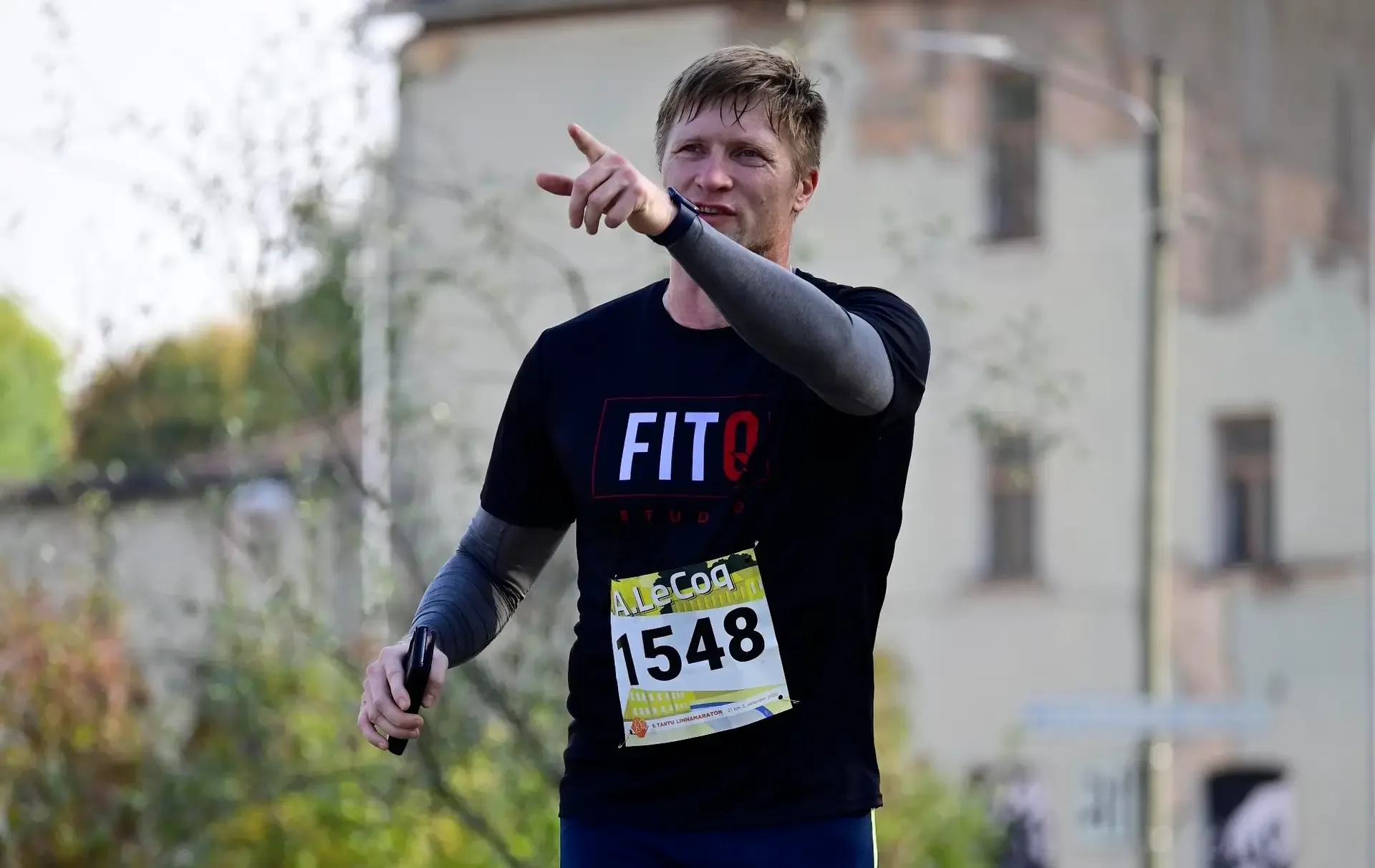

We asked FitQ CEO Marti Soosaar a few questions about FitQ’s past, present and future.
Let’s start with the main question. What is FitQ?
FitQ is a software solution designed to give trainers a tool for selling their expertise to the world. Even in a country as small as Estonia, there are hundreds of trainers. Through their clubs, they reach a few hundred people, most of whom are concentrated in the major cities. At the same time, many people lack access to high-quality training. FitQ allows trainers to reach trainees online, find new followers and help more people get active.
How did FitQ get started?
Then COVID arrived. Gyms were closed in the spring, trainers were placed on unpaid leave, and together with the Stebby team—then still called SportID—we started thinking about how to get our clients moving while they worked from home, how to stop trainers’ equipment from gathering mould and how to give trainers an opportunity to earn money. At the time, we compiled a daily schedule of video workouts offered by trainers. We emailed our clients and encouraged them to pay a monthly fee through Stebby for training at home. We then divided that money among the trainers according to how many viewers each of them attracted. We entered all the viewing figures in an Excel spreadsheet based on Facebook’s viewing statistics. We also ran plenty of workouts ourselves with trainers from Tartu—2-3 on some days—so in addition to working our abs, we gained experience in broadcasting live video. As we continued talking to trainers, the idea gradually developed into a unified service.
Why do people use FitQ?
First, to get fit at home. Second, because their favourite trainer invites them to work out, and the workout is in their native language.
Who are FitQ’s main target audiences?
Looking beyond COVID, the three main target audiences are:
a) people who do not live in major cities and do not have access to good training or a friendly trainer where they live
b) people who live in major cities but do not want to spend 30 minutes a day travelling to a workout and another 30 minutes coming home. If you work out three times a week, that is an hour out of your day and 156 hours out of your year.
c) people who are only starting to become active, feel self-conscious with other people watching and would prefer to work on their fitness at home in private.
We are certainly targeting more women than men, with a ratio of around 3:1 in favour of women. The largest age group is 25-45-year-olds.
Competition in the video workout sector is incredibly fierce. There are plenty of video workout apps, including Estonia’s own Netfit, not to mention YouTube.
That is true. We have to acknowledge that working in this field and investing money in it is undoubtedly a high-risk investment. At the same time, Estonians are a start-up nation capable of creating excellent services that succeed globally, even in highly competitive fields such as ride-sharing.
We believe we can create something much more exciting than the average workout app and use it to capture the attention of a larger audience—and persuade them to open their wallets. To achieve that, we are bringing trainers on board, which is an unconventional approach in the world of workout apps. The conventional model would be: my app, my content. Our approach is more like Spotify: we want to offer a good platform to good content creators, but also, why not, to average ones. It is a democracy, and ultimately the channels that think through their content more carefully and produce it to a higher standard are more likely to take off. After all, Avicii has more streams on Spotify than Üllar Jörberg, but both Jörpa and the owners of Avicii’s copyrights are free to upload content.
If you are a very good trainer today but not a very good IT specialist, how can you sell your workouts online to thousands of people? YouTube will not pay you a reasonable amount for them. Imagine attracting 1000 viewers to one of your workouts and earning 2 euros from it. In Estonia, 1000 viewers and participants for a single workout is a very respectable number, but earning €2 from them is pointless. And how realistic is it to reach 10 000 or 100 000 viewers with a single workout? Not in a market the size of Estonia, and it is probably almost impossible even in a large market such as Poland. You can also sell through Facebook, Instagram or Zoom. But can you imagine all the administrative work involved? Who has paid you and who has not? Whose viewing access expired the day before yesterday? Has the person asking to join your group or video call paid for today’s workout? If not, will you remember to send them a reminder after the workout and later check whether the payment has arrived? Where do you even find these people, and how do you tell them when the workouts take place? The questions never end.
If we can create the ideal tool for trainers, allowing them to reach people in Karksi-Nuia, Orissaare and Narva-Jõesuu with their workouts, collect ticket revenue from them and turn them into fans, then we will have done our job well.
I would also like to give our trainers a small personal development goal that I found in Pat Flynn’s book “Superfans”, which I read last week. Gain at least 1 new fan every day, and in three years you will have 1000. Collect 10 euros from each fan every month, and you will have a business with six-figure annual revenue: 1000 fans multiplied by 120 euros per year. That seems achievable even in Estonia.
What are FitQ’s plans for the future?
At the moment, we have a minimum viable solution with paying customers and even a few fans who speak very highly of us. The platform features workouts from 40 trainers in Estonia and Lithuania. We now want to get the next few important features up and running. The first is selling tickets for individual channels, which will allow trainers to earn money directly from their fans. At present, trainers earn through general platform passes based on their number of views.
Second, home workout programmes. These are something people search for online. They are interested in keywords such as home workout programme, beginner’s workout plan and fat-burning at home. We are creating a way for trainers to build their own personal workout programmes. In addition to the ever-popular fat-burning programmes, why couldn’t our platform also offer programmes such as “Learn to do a handstand in 10 hours” or “Practise volleyball forearm passes at home without breaking the chandelier”?
In the future, we want to create tools that allow trainers to offer personal consultations by video call, as well as enabling personal trainers to create workout plans for clients and monitor their completion. The latter could also take the form of a diary.
You have also trained as a trainer yourself. So when will your workouts be coming to FitQ?
I have just finished Robin Sharma’s book “5 AM Club”, and it gave me the idea of testing his method on myself. According to Sharma, it takes 66 days to form a habit. One of his main recommendations is to wake up at 5 a.m. and start the day with a 20-minute workout that is hard enough to make you sweat, so I thought: why not turn these short workouts into video workouts? My 13-week personal challenge is therefore to broadcast one 20-minute workout on the FitQ platform every morning at 5 a.m. You are welcome to take on the challenge with me, and together we can see whether I manage to last 66 days.
Why are live workouts necessary at all? Why isn’t it enough to offer people the option of following a video later?
Live workouts have their own appeal because they happen here and now. I have to step out of my comfort zone immediately, and postponing it is not an option. Why do people go to a rock concert to hear their favourite band when the music sounds much better on Spotify or a CD? Or why go to a fitness club for BodyCombat when Les Mills on Demand allows you to join world-class instructors in workouts with incredible production values?
Second, running live workouts ensures a steady stream of new material. On our platform, we see that people do not want to do the same workout twice—or even if they sometimes do, in the bigger picture they still eventually want something new. Novelty helps the brain cope better with the training load.
To return to the rock music example, if you are my age, there is a good chance that you think Foo Fighters’ “The Colour and The Shape” is a very good album. But for some reason, you have still listened to and bought new music since then—and discovered some excellent new things.
Stebby’s investors have asked why FitQ did not remain under Stebby’s wing and brand.
Mainly because it is a completely different product. At Stebby, we are building a marketplace for health services in which companies are key stakeholders and one of the central values underpinning everything is the healthy employee. At FitQ, we have turned our attention towards trainers and are building the product with the trainer—and their mission to get people moving—at its centre. Another important reason was that, over the years, Stebby had assembled a team with shared values, and its members had their own reasons for joining that team. We had common goals for product development and expansion into new markets. It felt complicated and demotivating for the team to announce at an eight-year-old company: yo, we’re pivoting now and are going to start doing something completely different.
For a while, we tried running both under the same roof, but it quickly became clear that both products were suffering. However, we believe that working in tandem as two applications can sometimes give us an advantage. FitQ is benefiting to some extent from our previous experience of building Stebby. I personally gained invaluable experience that is now extremely useful to apply. It is also much easier for FitQ to reach Stebby’s customers. Through FitQ, meanwhile, Stebby gains new service providers who, in addition to video workouts, have an excellent opportunity to sell outdoor workouts, personal training, workout plans and more on the Stebby platform. I am especially optimistic about the future of this collaboration because FitQ’s system architecture makes it not merely several times but dozens of times easier to expand into foreign markets than it is for Stebby. The support this could provide by creating new contacts and networks could therefore be significant.
